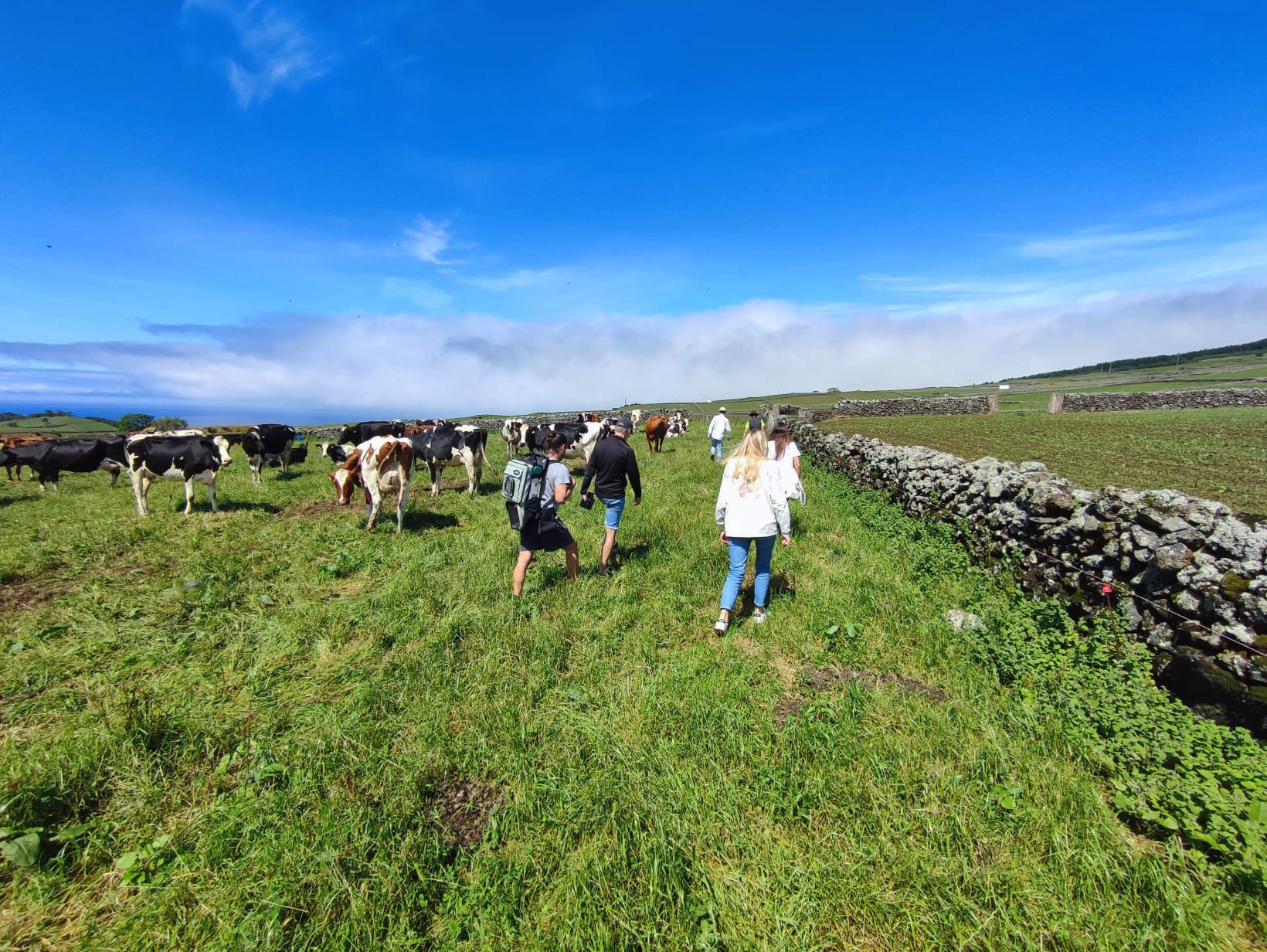
Field Campaign in the Azores
During the field campaign on Terceira Island in the Azores, we measured the spectral signatures of grass across a range of pastures at different altitudes and under varying environmental conditions.
Our goal was to understand whether these spectral patterns differ between grass samples colonized by spores of Pithomyces chartarum, a fungus linked to livestock health risks, and those without spores. To capture this variability, we combined multiple data sources: satellite imagery (Sentinel-2), drone-based observations, and in situ measurements with a field spectroradiometer. This multi-scale approach let us link ground-truth data directly to remote sensing signals.
In this campaign, we did not detect significant differences in spectral signatures between grass with and without spores. Meteorological variables over the preceding 90 days, however, proved useful for predicting sporulation risk. The resulting dataset still provides a foundation for analyzing how grass quality and nutrient composition relate to spore production, and by leveraging existing vegetation indices and potentially developing new ones tailored to our observations, we aim to improve the detection and monitoring of these conditions from remote sensing platforms.
You can read the full paper here.